International Conference
DISASTER AND ITS AFTERLIFE
(DAIA-2025)
A Multidisciplinary Response to Environmental Crises from North-Bengal and North-East India
1, 3 & 4 November, 2025
Organisers:
IQAC, Dhupguri Girls’ College, Jalpaiguri
in collaboration with
IQAC, Gour Mahavidyalaya, Malda
Venue:
Dhupguri Girls’ College

Our Sponsor



Our Co-Sponsors


North Eastern Society for the Preservation of Nature and Wildlife (NESPON)
Publication Partner


Call For Papers
Disasters—floods, landslides, cyclones, droughts are increasingly frequent in North Bengal and North–East India. However, in such environmental disasters, like, the Glacial Lake Outburst Flood (GLOF) that struck Sikkim and North Bengal on 4 October 2023 attention immediately shifts to the causes, casualties, and economic loss, often sidelining the long-term stories of survival, adaptation, and the multi-species habitus that sustains life. We call these registers the “afterlife of a disaster”: the layered, prolonged, and often overlooked processes of rebuilding, readjustment, and ecological rearrangement that unfold after immediate media attention recedes. This conference brings together scholars, practitioners, geographers, community leaders, artists, and policy makers to trace those afterlives, foregrounding human and non-human narratives, intersectional experiences (location, culture, demography) and novel interdisciplinary methods across the environmental humanities and allied fields. We propose to rethink North Bengal and North–East India from the perspectives of plants, animals, birds, mountains and rivers, and explore how biotic and abiotic entanglements enable or constrain post-disaster life.
Sub-themes:
Themes may include, but are not limited to:
Landscapes of risk: geomorphology, hydrology, slope instability and hazard zonation.
Geospatial technologies: GIS, remote sensing and participatory mapping for disaster analysis.
Transboundary rivers and cross-border governance in disaster management.
Applications of AI and machine learning for disaster prediction and risk mapping.
Community-based adaptation and resilience from a spatial and regional perspective.
Ecological restoration, biodiversity loss and long-term environmental change.
Climate change and extreme events: droughts, cyclones, floods and GLOFs in fragile ecologies.
Multi-species resilience and the ethics of coexistence after disasters.
Environmental humanities methodologies for studying disaster afterlives.
Oral histories and collective memories of disaster aftermath: voices from marginalized communities.
Displacement, migration and resettlement: shaping new cultural and social geographies.
Intersectionality of vulnerability: gender, caste, class, ethnicity, and displacement.
Cultural, linguistic and artistic responses to disaster afterlives.

Important Dates
Last date of abstract submission: 27 October, 2025 [All abstracts will be peer- reviewed by the Screening Committee.]
Acceptance of abstracts will be notified by E-mail: 29 October, 2025
Last date of registration fees Payment: 27 October, 2025(Up to 5.00 pm.)
Decision by Screening Committee for full paper submission for the Seminar Proceeding will be notified by E-mail: 30 November 2025
Send your abstract : conferencedhupguri@gmail.com
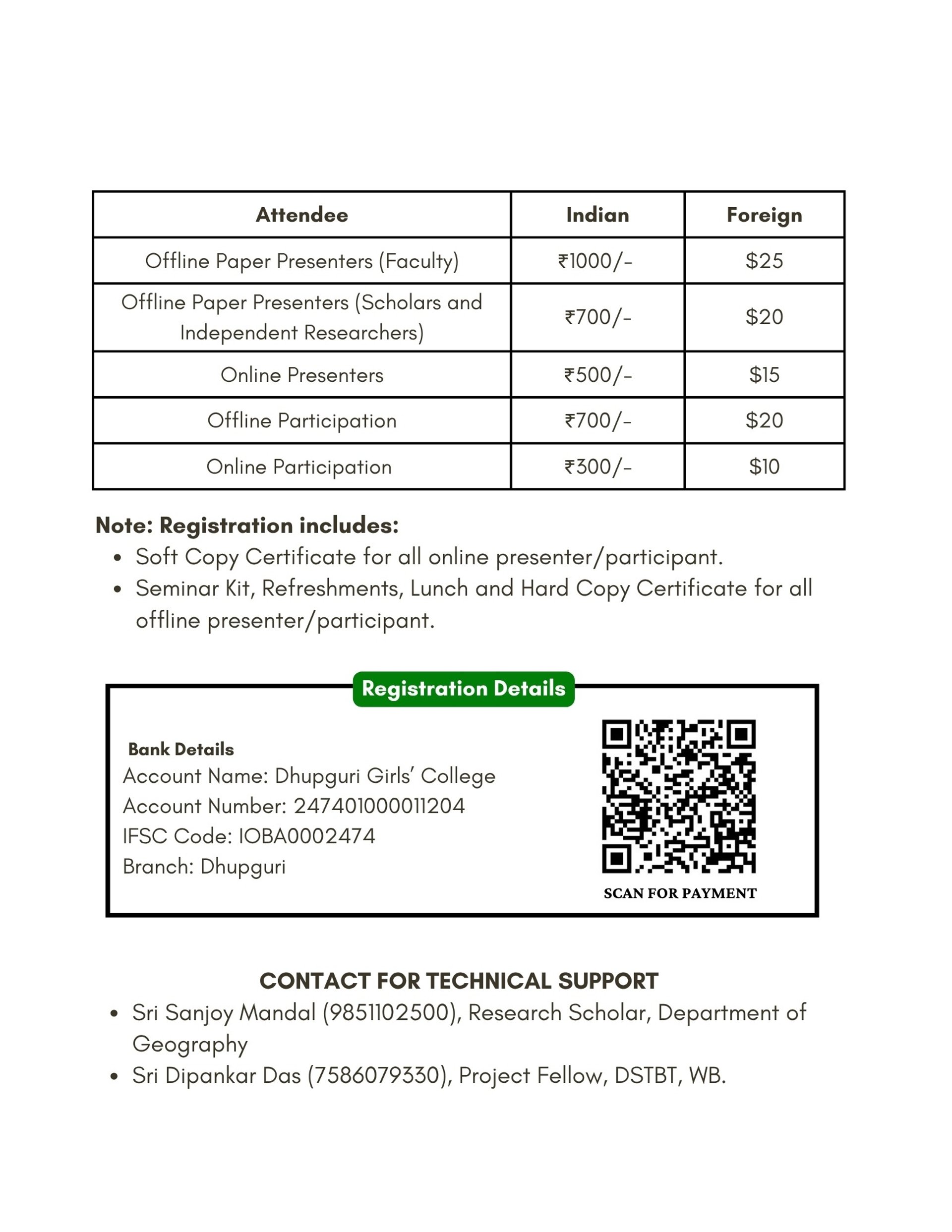
Registration Fees
About Dhupguri Girls’ College
Dhupguri Girls’ College (2013), situated in a rurban belt of Dhupguri sub-division, Jalpaiguri, is committed towards nurturing the aspirations of young underprivileged girls for higher education, amidst lots of challenges and impediments. Having procured, B+ in NAAC (2025) in its first attempt, the college aims to deliver quality education and innovative practices of thinking in days to come. This vision of the college has continued to grow in the last few years through an optimum utilization of its limited resources and funds.
About Gour Mahavidyalaya, Malda
Gour Mahavidyalaya, affiliated to University of Gour Banga, started its journey on 5 September 1985, and since then it has been providing quality education to students of the Gour Banga region of Malda. The college has been recently accredited with B++ grade by NAAC (3rd Cycle). It offers undergraduate, post-graduate, vocational and skill-oriented courses that are recognised by Central and State governments. With over 7000 students, and cutting-edge courses on food & nutrition, mass communication, health care and so on, the college stands at the threshold of adapting to new opportunities that NEP 2020 has ushered.